

It is undeniable that China is a major player in the prolonged and devastating war between Russia and Ukraine in 2022. Officials and experts have expressed pressure on, or had expectations that, China behave as they wish, but we must analyze the true motives behind the game of the Chinese Communist Party (CCP). To do so, it is useful to dive into history.
Mao Zedong’s 1925 book, Analysis of the Classes in Chinese Society, began by saying: “Who are our enemies? Who are our friends? This is a question of the first importance for the revolution.” The line, known to generations of Chinese, provides the key to understanding the CCP’s strategy and tactics throughout the century.
To defeat an enemy, the CCP allied with any party, even infamous ones, to form the so-called “united front,” in order to weaken, distract or divide the enemy. When the moment was not favorable to them, they quietly built up strength but stayed hidden while they grew stronger and waited for the right time. When the time was right, they would deliver a fatal blow. Deception is necessary because illusions can confuse the enemy.
A classic example was the war between China and Japan from 1937 to 1945 during World War II. The CCP took advantage of the conflict to massively grow its own military strength while exhausting its archenemy, the government of the Republic of China under the Chinese Nationalist Party (KMT), led by commander-in-chief Chiang Kai-shek.
After Japan’s large-scale invasion in September 1937, Mao Zedong openly called on “all political parties and groups, as well as the people of the whole country, to organize a united army and an anti-Japanese national defense government for a common struggle against Japanese imperialism.” By contrast, at a high-level CCP meeting held a month earlier, Mao advised his comrades: “Do not be deceived by patriotism and do not go to the front to play anti-Japanese heroes. We must know that the damage from Japanese planes and artillery will be much greater than what Chiang Kai-shek did to us before.” Mao ordered CCP forces to avoid direct confrontation with the Japanese front. Instead, he ordered them to go behind enemy lines to engage in guerrilla warfare with the task of expanding the territory and troops under CCP control.
Under the banner of anti-Japanese cooperation with the Kuomintang, the CCP renamed its Red Army and its guerrilla troops the Eighth Route Army and New Fourth Army, while placing them under the nominal control of the nationalist government. Both CCP armies wore nationalist uniforms, flew the flag of the Republic of China, and took weapons, money and supplies, but did not take orders from the Kuomintang government. Instead of fighting the Japanese, they stabbed commander-in-chief Chiang in the back, launching relentless attacks against Kuomintang troops, de facto cooperating with Japan’s ambition to conquer China.
Historians, comparing and contrasting Japanese and Chinese sources, found evidence of the CCP’s collusion with Japan. Mao instructed his red spies to sell military information obtained from Chiang Kai-shek’s government to the Imperial Japanese Army in order to cripple the KMT forces. After the CCP took control of mainland China in 1949, Mao Zedong repeatedly thanked visiting Japanese guests for Japan’s invasion, stating without hesitation that without Japan’s help, the CCP would not have been able to defeat the Nationalist Party. In 1972, Mao returned the favor by renouncing Japanese war reparations.
Throughout the eight bloody years, the Kuomintang government fought more than 20 large-scale campaigns and about 1,000 major battles, losing more than 3 million soldiers, including more than 100 general-grade officers. All of its naval ships were sunk, 2,500 warplanes were shot down and 4,000 air force pilots died. By contrast, in 1945 the CCP occupied vast areas of northern China and commanded a formidable force of more than a million soldiers, 50 times its size in 1936.
The result? When the whole nation, amid rubble and debris, finally won the hard war and no longer needed it, the CCP’s war arrived. With Stalin’s help, after years of hiding, the CCP defeated the Kuomintang government in three years.
After 1949, the United States became the CCP’s enemy number one. In the book The Hundred-Year Marathon: China’s Secret Strategy to Replace America as the Global Superpower, foreign policy strategist Michael Pillsbury wrote that China has a long-term strategy to subvert the U.S.-led world economic and political order. The goal is to replace it with communism by 2049, the centenary of the CCP’s coming to power in China.
Internationalism is in the DNA of communism. In the early days, the Soviet Union used internationalism fiercely to advance the communist sphere of influence across Europe. Meanwhile, Mao did the same, supporting communist insurgencies across Asia. Beginning in the 1990s, Beijing became the new showcase of the movement, surreptitiously infiltrating every fiber of Western society while trying to carry out the revolution from within.
The tactics may be different, but the goal remains the same: to dominate the world with communist ideology. The Chinese Communist Party remains a Marxist party with the goal of toppling the “old world” by destroying all states, nations and classes, to “liberate all humanity” or, in the words of Xi Jinping, to build a “Community of Common Destiny for Mankind.” To achieve this, the CCP has to overthrow the United States, the shepherd of the current world order. The CCP is well aware that one day the final confrontation is inevitable. That is why it is preparing for an all-out offensive against the United States. Arthur Waldron, a China expert and professor at the University of Pennsylvania, noted at a Senate hearing in 2004: “Americans should understand that the new Chinese army is the only one being developed today anywhere in the world that is specifically configured to fight the United States.” (1)
The current war between Russia and Ukraine has allowed the CCP to play its old tricks again. The war relieved the CCP of the greatest international pressure it has faced since the U.S.-China trade war and the ensuing COVID-19 pandemic, similar to how the Japanese invasion successfully prevented the Kuomintang government from annihilating Mao’s Red Army. Now Russia, not China, has become the world’s enemy number one. While the atrocities in Ukraine have drawn the world’s attention, the CCP happily steps aside, potentially out of danger. Even after the war ends and the dust settles, Russia will remain the center of attention, at least for a while. Under the pressure of Western sanctions, the West’s turning away from Russia is good news for China. Moscow is now even more in China’s pocket and will depend on it as never before.
Without a doubt, Beijing will support Russia in the same way it colluded with Japan in its day. What better way to distract and occupy the West than with a prolonged war in Europe? Turning Russia into a giant-sized North Korea would cause the West ten times more inconvenience compared with the Kim family. If Russia can no longer be the bulwark against the West, then the CCP itself will become the next target. Liu Xin, a host on China’s state television network China Global Television Network (CGTN), commenting on Biden’s threat to Xi if China supports Putin’s war, said Biden’s request was like saying: “Can you help me fight your friend so that I can concentrate on fighting you afterward?” At the opening of the 2022 Beijing Winter Olympics in February, China and Russia declared a “limitless” friendship and cooperation with “no forbidden areas.” At the end of March, Russian Foreign Minister Sergey Lavrov and his Chinese counterpart Wang Yi pledged again: “Both sides are more determined to develop bilateral relations and have more confidence in advancing cooperation in various fields.”
Unlike the Japanese invasion, which seriously hit the Kuomintang government, the war between Russia and Ukraine has done little to seriously harm the U.S. For Beijing, more needs to be done, such as working in other countries to isolate the U.S.
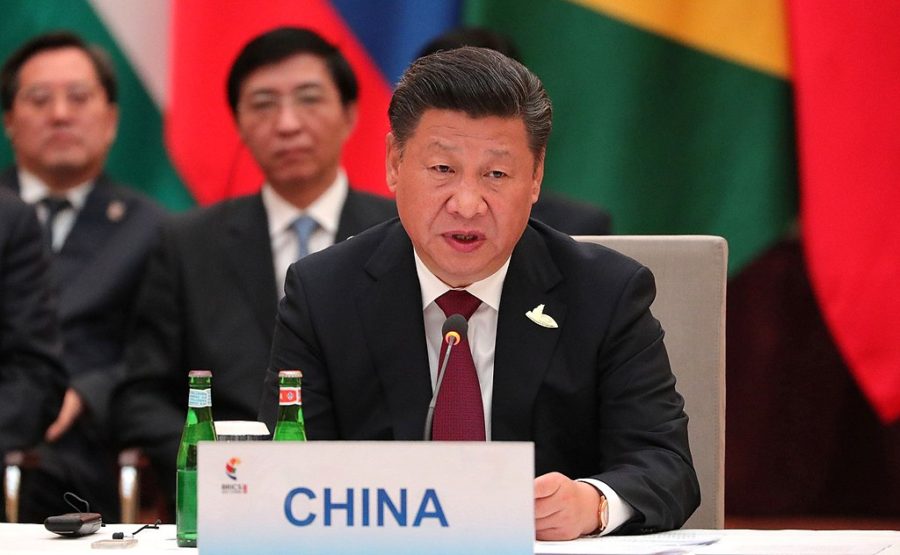
During a video conference with European Council President Charles Michel and European Commission President Ursula von der Leyen on April 1, Xi Jinping told EU leaders to “formulate an independent China policy” and “take a leading role in the resolution of Ukraine.” The underlying message was clear. The European Union must not follow the United States in formulating China-related policy, and the European Union must not be the United States’ confidant in relation to the Ukraine crisis. Disconnecting the EU from the American fold was the CCP’s long-term goal. Meanwhile, the CCP’s carrot and stick approach to trade policy in the EU went a long way. Since 2021, the EU has become China’s largest trading partner in terms of total imports and exports. Now that energy-rich, nuclear-armed Russia stands as the main and imminent threat to EU security, China may even leverage its relationship with Russia to influence its European interests.
On March 1, the United Nations voted on a resolution opposing Russia’s invasion of Ukraine and calling for the immediate withdrawal of Russian forces. India was among the 35 countries that abstained. The CCP was shrewd enough to seize the opportunity of India’s disagreement. During the previous U.S. administration, India was a strong ally of the United States. The two countries exchanged visits by heads of state, and Prime Minister Modi developed a friendship with President Trump. For China, sharing 2,000 kilometers of its border with a neighbor that partners with its greatest enemy is cause for concern. Against this backdrop, the 2020 China-India border conflict broke out. Seeing new cracks in the India-U.S. alliance, China’s Wang Yi rushed to New Delhi in late March to tell India that “both countries must not allow (border disputes)” to “define or even affect general ties.” It is not clear whether India got Wang’s message, but Beijing will surely manipulate the Washington-New Delhi-Moscow triangular relationship to its advantage.
The United States and the EU have threatened Russia-style sanctions if China decides to support Putin’s war or invade Taiwan. But is that a problem? Beijing is famous for making promises and never keeping them. Leaving aside the World Trade Organization (WTO) promises, what about the phase one trade deal between the U.S. and China signed in 2020? China agreed to “expand purchases of certain U.S. goods and services by $200 billion over the two-year period from January 1, 2020 to December 31, 2021, above 2017 baseline levels.” After the two-year period had passed, China had bought only 57% of its original commitment. So far there has been no reaction from the Biden administration. If the CCP can get away with failing to keep its promises again and again, it will surely cheat again and again. When tempers flare, verbal assurances are all it takes to appease Western politicians.
Since the birth of the Chinese Communist Party, it has survived by betrayal and thrived by deception. After one hundred years, the CCP has become an expert at feigning “united fronts,” at mastering “divide and conquer,” at perfecting its game of “hiding,” and at refining its deception. Georg Hegel once said: “We learn from history that we do not learn from history.” To deal with the CCP in a way that is neither too simple nor too naive, it is vital that we learn from history.
End note:
(1) Testimony of Arthur Waldron, Lauder Professor of International Relations, Department of History, University of Pennsylvania https://www.globalsecurity.org/military/library/congress/2004_hr/040422-waldron.pdf
This article was originally published in China Scope on May 29, 2022.