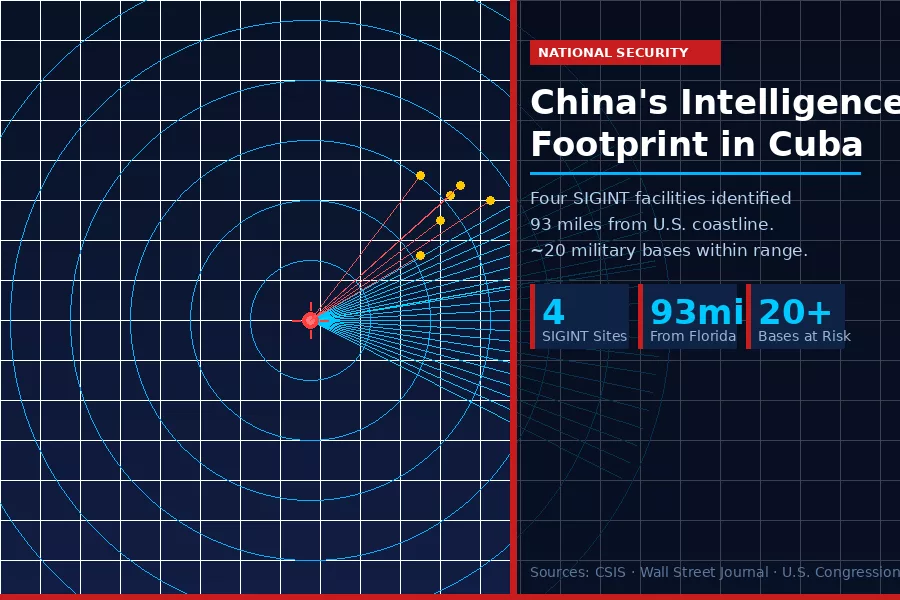



Cuba’s geographic position, 93 miles (150 kilometers) south of Florida, has made the island a strategically valuable location for collecting signals intelligence since the Cold War. Today, according to multiple U.S. government sources and independent research, that position is being exploited by China.
From Soviet Antennas to Chinese Operations
When the Soviet Union disintegrated in the early 1990s, it left behind an extensive network of signals intelligence (SIGINT) facilities across Cuba. The most prominent was the Lourdes Signals Intelligence Complex near Havana, the Soviet Union’s largest listening station outside its borders. At its height, the facility housed about 1,500 operatives and supplied the Soviet Union with roughly 75 percent of its military intelligence, according to congressional testimony in May 2025 by Ryan Berg of the Center for Strategic and International Studies (CSIS). Lourdes was formally closed as an intelligence facility in 2002.
China’s entry into this field began in February 1999, when Chinese Defense Minister Gen. Chi Haotian visited Havana and met with then Cuban Defense Minister Raúl Castro. According to an article in El Nuevo Herald published at the time, both sides signed an agreement giving China access to several former Soviet listening stations on the island, including the Bejucal facility, located less than 10 miles from the former Lourdes site. A leaked Federal Communications Commission report cited at the time also claimed that China had supplied jamming equipment designed to block Radio Martí broadcasts to the island.
Four Identified Sites
In 2023 and 2024, CSIS published two open-source analyses of Chinese intelligence activity in Cuba using commercially available satellite imagery. The research identified four specific facilities as highly likely sites of Chinese signals intelligence operations targeting the United States.
Three of the sites are in the Havana metropolitan area: Bejucal, Wajay and Calabazar. All three are legacy facilities from the Soviet era. A fourth site, El Salao, is located at the island’s eastern end, near Santiago de Cuba, and is a recently built facility, the only one of the four that does not come from Cold War infrastructure.
In updated imagery published in May 2025, CSIS reported two significant developments. At El Salao, construction activity appears to have ceased according to imagery captured in April 2025, and previously maintained areas show signs of abandonment. At Bejucal, by contrast, the analysis found evidence of active upgrades: some antennas have been removed to make way for a large circularly disposed antenna array (CDAA), and satellite captures show dishes changing position, which analysts interpret as a sign of active operations.
What These Facilities Can Do
SIGINT systems use antenna arrays to intercept electronic signals. A key technology identified at the Cuban sites is the CDAA, capable of collecting signals from multiple directions simultaneously without physically repositioning the equipment. Because of Cuba’s proximity to Florida, CSIS analysis estimates that these facilities provide potential coverage over approximately 20 military bases and installations on the Florida peninsula. Among the most significant installations within theoretical range are Naval Air Station Pensacola, Tyndall Air Force Base, MacDill Air Force Base, Naval Air Station Key West, Naval Submarine Base Kings Bay, Cape Canaveral and the headquarters of U.S. Southern Command.
The Diplomatic Record
The defense relationship between China and Cuba has deepened incrementally over the past two decades. Chinese warships made an unusual port call in Havana in November 2015, marking the 50th anniversary of China-Cuba relations. In April 2024, He Weidong, Vice Chairman of China’s Central Military Commission, met with Cuban military officials and described the relationship between the two countries as an “unbreakable friendship.” Cuba formally joined the BRICS economic bloc as a partner country on January 1, 2025.
In June 2023, the Wall Street Journal reported that Cuba had agreed to host Chinese spy facilities in exchange for financial support worth several billion dollars. The U.S. Department of Defense initially called the report “inaccurate.” Three days later, National Security Council spokesman John Kirby acknowledged the Chinese intelligence presence in Cuba, noting that it had existed since at least 2019. Additional reports soon emerged indicating that China had been seeking to build a joint military training facility on the island that could house Chinese troops.
China’s Ministry of Foreign Affairs described the original Wall Street Journal report as “completely false and baseless.”
Cuba’s Digital Infrastructure
Beyond signals intelligence, China also built Cuba’s telecommunications infrastructure. The main suppliers to Etecsa, the island’s only internet provider, are Huawei, TP-Link and ZTE, according to CSIS testimony. The Swedish digital security organization Qurium has reported that Cuba uses Huawei’s eSight network management software to filter internet searches. During the July 2021 protests in Cuba, authorities cut internet and telephone services across the island.
Economic Context
The Cuban economy has deteriorated significantly in recent years. The country recorded inflation of 30 percent and a GDP decline of 2 percent in 2023, according to figures cited in the CSIS testimony. Cuba has received approximately $369 million in development financing from China, although analysts note that this is far below the island’s broader financial needs. Venezuela, historically Cuba’s other major economic partner, has been unable to sustain its former levels of oil and financial support.
In early 2025, the Trump administration cut off Venezuelan oil shipments to Cuba following the capture of Venezuelan President Nicolás Maduro. Since then, a U.S. naval presence has deterred commercial vessels from unloading cargo at Cuban ports. Cuba’s power grid has suffered multiple island-wide blackouts as a result of fuel shortages.
Recommended Responses: Perspectives from Experts and Lawmakers
In his congressional testimony in May 2025, Berg outlined several recommendations for U.S. policymakers. These included classified briefings for all members of Congress on China’s SIGINT operations in Cuba; selective declassification of satellite imagery to publicly document Chinese activities; and the articulation of clear red lines, specifically that the permanent installation of offensive military capabilities or the stationing of People’s Liberation Army combat assets in Cuba would constitute a significant escalation. Berg also recommended that the U.S. Cybersecurity and Infrastructure Security Agency (CISA) work with private-sector companies operating near Cuba’s SIGINT coverage areas, including space launch operators at Cape Canaveral, to improve communications security.
Berg further recommended that the U.S. State Department reach out to neighboring countries such as the Bahamas, the Dominican Republic and Jamaica, arguing that CDAA technology collects signals omnidirectionally and poses potential intelligence risks to those nations as well.