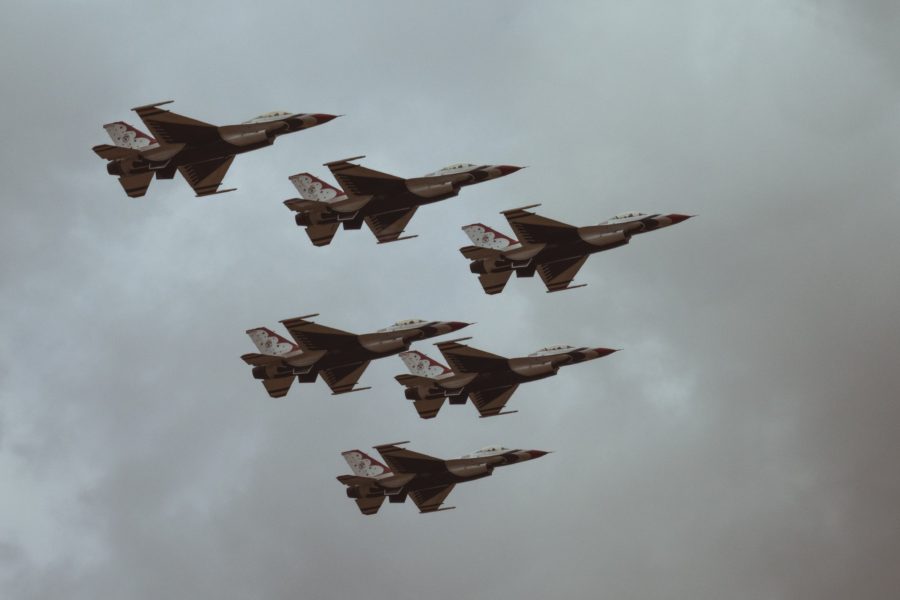




Tensions continue to rise in the South China Sea as China, or rather the Chinese Communist Party (CCP), intensifies its military activities in the region. In just the first four days of October, China made a record 150 incursions into Taiwan’s air defense identification zone (ADIZ), after China’s People’s Liberation Army Air Force (PLAAF) had already set another monthly record in September with 117 incursions, some of them involving nuclear-capable bombers, fighters and reconnaissance aircraft. The incursions were, reportedly, the highest monthly number recorded since Taiwan’s Ministry of National Defense began reporting Chinese air incursions 13 months ago. In addition, August saw the first incursion of Chinese military helicopters into Taiwan’s ADIZ, and experts suggest the PLA was probing Taiwanese defense capabilities by using different aircraft.
Also in August and September, China conducted assault exercises near Taiwan with warships, early-warning aircraft, anti-submarine aircraft and bombers. “The joint fire assault and other drills carried out by Eastern Theater Command troops are a necessary action to continue safeguarding China’s sovereignty in the current security situation in the Taiwan Strait,” Colonel Shi Yi, spokesman for the PLA Eastern Theater Command, said, “and also a solemn response to the interference of foreign forces and the provocation of ‘Taiwan independence’ secessionists.” Shi stated that military exercises will be “held regularly” depending on the situation in the Taiwan Strait and the “need to maintain sovereign security.” China carried out 20 naval island-control exercises in the first half of 2021, compared with 13 in all of 2020.
This activity, in addition to diplomatic and economic pressure, is evidently intended to wear Taiwan down and force it to capitulate to China and give up its independence without China firing a shot. “China is applying a comprehensive approach that seeks to coerce, corrupt and co-opt the international community,” former US Indo-Pacific Command commander Philip Davidson recently warned, “so that they can achieve their geopolitical advantage (…) to force Taiwan to capitulate through extreme diplomatic and economic pressure and strain.” Failing that coercion, Davidson estimates:
“The changes in the [People’s Liberation Army’s] capabilities, with its missile and cyber forces, and its training capacity, the advancement of its joint interoperability and its combat support logistics, all those trend lines tell me that within the next six years they will have the capability and the ability to reunify Taiwan by force, if they choose the option of force to do so.”
READ ALSO: China Is “Secretly Building Up” a Massive Nuclear Arsenal
With China’s assessment of America’s lack of resolve to protect its allies (China’s illegal takeover of Hong Kong and the Taliban’s takeover of Afghanistan, where the United States did not even manage to rescue all American citizens), China could be planning to use force to capture Taiwan well before then, while the opportunity looks attractive. The question is whether, should China attack Taiwan, the US will defend the island, or even put serious deterrence measures in place. It will only help the Chinese Communist Party if the consequences of invading Taiwan amount merely to a “strongly worded card.”
Taiwan’s Defense Minister Chiu Kuo-cheng announced on October 6 that China already has the capability to invade his country. “By 2025, China will bring the cost and attrition to a minimum. It has the capability now, but it will not easily start a war, having to take many other things into account.”
Elsewhere in the South China Sea, also in September, the PLA air force carried out troop transports with several large Y-20 transport aircraft to three airstrips in the Spratly archipelago, where China has built and militarized artificial islands on the reefs, according to Chinese state media. Global Times, the mouthpiece of the Chinese Communist Party (CCP), wrote that the aircraft “carried out amphibious landing exercises under complex conditions, showing the PLA’s capabilities to safeguard peace and stability in the region.” It was the first time the PLA confirmed it had used aircraft of this type to transport personnel to the islands. Vietnam, which also claims sovereignty over the disputed Spratly archipelago, protested China’s transport mission to the islands and called it a violation of Vietnam’s sovereignty.
READ ALSO: Armed Chinese Ships Enter Japanese Waters Again
“Surely, this announced feat is aimed at demonstrating the PLA’s capability of force projection across vast maritime distances in the South China Sea,” Collin Koh, a research fellow at Singapore’s S. Rajaratnam School of International Studies, said:
“And ultimately it is also meant to show that the airstrips built on the artificial islands are capable of supporting flight operations by large aircraft. If they can support the Y-20, so can the H-6 bomber.”
China considers almost the entire South China Sea, an area of about 3.5 million square kilometers, and its estimated 190 trillion cubic feet of natural gas and 11 billion barrels of oil, in addition to marine resources such as fisheries, to be Chinese territory. The Permanent Court of Arbitration in The Hague firmly rejected China’s sovereignty claim in 2016, but five years after that ruling, China continues to reject the tribunal’s authority. China’s sovereignty claim over the South China Sea, and its will and ability to enforce it, has long created friction with countries in the area that claim their own parts of the sea, such as Brunei, Indonesia, Malaysia, the Philippines, Taiwan and Vietnam.
China also regularly uses its large civilian fishing fleet to advance its objectives in the South China Sea. In March, a huge Chinese fishing fleet spread across Whitsun Reef, located in the Philippines’ exclusive economic zone. The Philippine government called on China to stop “militarizing the area.” Yet almost eight months later, more than 150 Chinese vessels remain in Philippine waters. On September 29, Philippine Foreign Secretary Teodoro Locsin Jr. said he wanted diplomatic protests to be filed “over China’s radio challenges against Philippine maritime patrols, the illegal restriction of Filipino fishermen from Masinloc Shoal (Scarborough Shoal) and the continued presence of Chinese ships near Iroquois Reef.”
READ ALSO: South China Sea: The CCP Turns Supply Ships into Mobile Surveillance Bases
In addition, China’s newly revised Maritime Traffic Safety Law (MTSL), which took effect on September 1, requires certain foreign vessels sailing in Chinese “territorial waters” to notify Beijing in advance. Foreign vessels such as foreign submarines, nuclear-powered ships, ships carrying radioactive, toxic or hazardous materials and any other ship that “may endanger the safety of maritime traffic” in China must provide information including the vessel’s name and number, its recent location, satellite phone numbers and dangerous goods. “Article 2 of the MTSL extends the application of the law from ‘coastal waters’ to ‘maritime areas under the jurisdiction of the People’s Republic of China.'”
“The term ‘maritime areas under the jurisdiction of the People’s Republic of China’ is not defined in the law and is intentionally vague,” Captain Raul Pedrozo, a professor of international law at the US Naval War College, wrote.
“The enactment of ambiguous and imprecise laws allows China to modify its position on the applicability of the law depending on the circumstances of the moment. Nevertheless, given China’s excessive maritime claims and its previous enforcement activities, the MTSL is likely to be applied to all waters and seabed areas (1) encompassed by the nine-dash line in the South China Sea, (2) extending to the Okinawa Trough in the East China Sea, and (3) beyond Ieodo (Socotra Rock) in the Yellow Sea… China is once again testing the international community to see how it will react to the enactment of another maritime law that exceeds the permissible jurisdictional limits of international law, as reflected in UNCLOS [the United Nations Convention on the Law of the Sea]. China will undoubtedly use the new law to conduct gray-zone operations below the threshold of armed conflict to intimidate its neighbors and further erode the rule of law at sea in the Indo-Pacific region.”
Vice Admiral Michael McAllister, commander of the US Coast Guard Pacific Area, said the revised law was “very concerning” and appeared to “go directly against international agreements and norms,” while setting “the conditions for instability and possible conflict” if enforced.
This seems part of China’s strategy of casting legal nets over the areas it claims… to “normalize” these claims,” said Robert Ward, senior fellow for Japanese security studies at the International Institute for Strategic Studies in London. “Enforcement will be difficult, but this may matter less to Beijing than the slow accumulation of what it sees as legal underpinning.” Philippine Defense Secretary Delfin Lorenzana has already said his country will ignore the revised maritime law. “Our stance on this is that we do not respect those laws of the Chinese within the West Philippine Sea because we consider that we have sovereign rights within these waters. Therefore, we will not recognize this law of the Chinese,” Lorenzana said during an event commemorating the Philippines’ Mutual Defense Treaty (MDT) with the United States.
The revised maritime law took effect only seven months after China’s new coast guard law came into force on February 1. The Chinese coast guard law gives the Chinese coast guard authority to use lethal force against foreign vessels operating in Chinese waters, including disputed areas such as the South China Sea. In January, the Philippines filed a diplomatic protest against the Chinese coast guard law, saying it is a “verbal threat of war to any country that challenges the law.”
Author: Judith Bergman, a columnist, lawyer and political analyst, is a Distinguished Senior Fellow at the Gatestone Institute.
This article was originally published by The Gatestone Institute on October 7, 2021.