


A group of U.S. defense experts operating from a fifth-floor suite in Washington, D.C. have been mapping out a hypothetical war between the United States and China over Taiwan.
“The results showed that in most scenarios, though not all, Taiwan can repel an invasion,” said Mark Cancian, senior adviser at the Center for Strategic and International Studies (CSIS), which simulated several war scenarios. “However, the cost will be very high for Taiwanese infrastructure and economy and for U.S. forces in the Pacific.”
In sessions that will run through September, retired U.S. generals and Navy officers and former Pentagon officials lean over tables like chess players alongside analysts from the CSIS think tank. They move forces represented as blue and red boxes and small wooden squares over maps of the Western Pacific and Taiwan. The results will be made public in December. Bloomberg
The basic assumption is that China invades Taiwan to force unification, to which the United States responds with its military. Another assumption (which is “far from certain”) is that Japan would grant “expanded rights” to use U.S. bases on its territory, but would not intervene directly unless Japanese territory were attacked.
Nuclear weapons are not part of the scenarios, and the weapons used in the simulation are those most likely to be deployed based on the current capabilities of the nations involved.
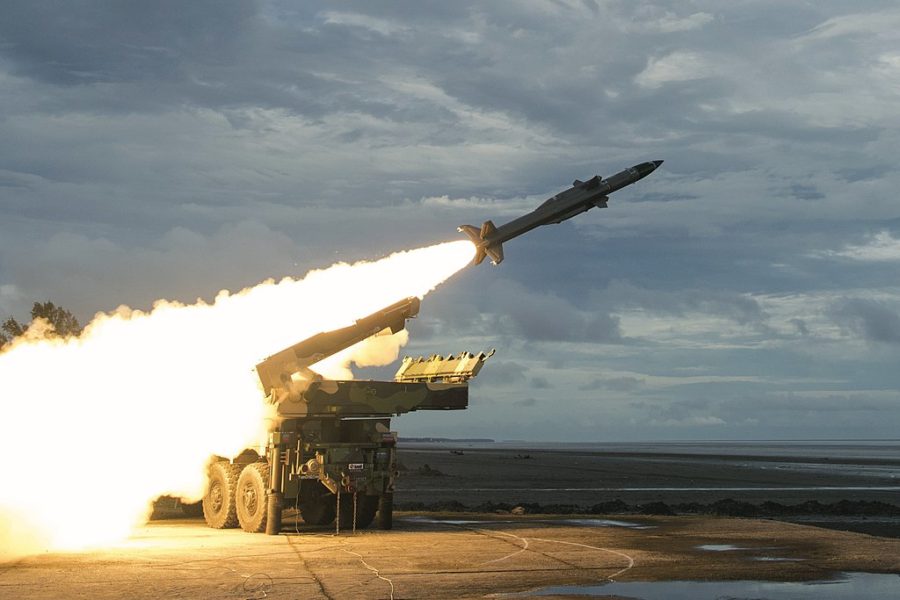
The news about the war games comes as China began test-firing missiles in recent days following House Speaker Nancy Pelosi’s (D) visit to Taiwan. So far, 18 of the 22 rounds of simulations conducted would result in Chinese missiles sinking much of the U.S. and Japanese surface fleet, and would destroy “hundreds of aircraft on the ground,” according to Cancian, a former White House defense budget analyst and retired U.S. Marine.
“However, allied air and naval counterattacks strike the exposed Chinese amphibious and surface fleet, eventually sinking about 150 ships,” he added.
“The reason for the high U.S. losses is that the United States cannot carry out a systematic campaign to take down Chinese defenses before closing in,” Cancian continued. “The United States has to send forces to attack the Chinese fleet, especially amphibious ships, before establishing air or maritime superiority.”
“To get a sense of the magnitude of the losses, in our latest iteration of the game, the United States lost more than 900 fighter/attack aircraft in a four-week conflict. That is roughly half the Navy and Air Force inventory.”
According to the simulations, the Chinese missile force “is devastating as long as the inventory lasts,” which makes U.S. submarines and long-range capable bombers “especially important.” Also key is Taiwan’s defense capability, because its forces would be primarily responsible for countering Chinese landings from the south.
“The success or failure of the ground war depends entirely on Taiwanese forces,” Cancian said. “So far, in all iterations of the game, the Chinese were able to establish a beachhead, but in most circumstances cannot expand it. The attrition of their amphibious fleet limits the forces they can deploy and sustain. In some cases, the Chinese were able to hold part of the island, but not conquer it entirely.”
“For the Taiwanese, anti-ship missiles are important, surface ships and aircraft not so much,” because surface ships “struggle to survive as long as the Chinese have long-range missiles.”
So far no estimates have been made of the lives lost, nor of the broad economic impact of such a U.S.-China conflict.
As Bridgewater’s Ray Dalio notes, “the tit-for-tat escalation between the United States and China is very dangerous.”
Unfortunately, what is happening now between the United States and China over Taiwan is following the classic path to war set out in my book “Principles for Dealing with the Changing World Order.” If events follow this path, this conflict will have a much greater global impact than the Russia-Ukraine war, because these are the world’s major superpowers, which are economically much larger and much more intertwined.
For reasons previously explained, the Russia-Ukraine war is minor by comparison, although the two conflicts are related and the Russia-Ukraine war, like all wars, is having terrible consequences. For example, consider that China’s share of world trade is more than seven times that of Russia [1] and makes up about 19% of all U.S. imports of manufactured goods. [2]
Imagine if importing goods from China and doing business with China became the same as it is now with Russia. Imagine what the supply chain and economic impacts on the world would be. Imagine what sanctions on China would be like for the world. Supply chains would collapse, economic activity would plunge and inflation would soar. And that is exactly what would happen to economies because of economic warfare, which would pale in comparison to the impact of military war, which we are obviously dangerously approaching.
For the reasons explained in my book, the situation that now exists between the United States and China is very similar to that which existed between the powers immediately before the First and Second World Wars and many other pre-war periods. The following chart shows my indicator of U.S.-China conflicts since 2000. As you can see, the readings of U.S.-China conflict are the highest in history.

This index is made up of many indicators, such as changes in military spending, personnel and deployment; the sentiment of people in each country about the other country; the media attention paid to the conflict; and so on. The combination of military spending and attitudes toward each rival country was especially indicative. The following chart shows the shares of global military spending of the U.S. and China, which significantly understates China’s military spending because much of the government spending that supports the armed forces is not included as direct military spending. Also, U.S. military spending covers the whole world, while Chinese military spending is more focused on the region. Informed parties tell me that China has significant military superiority over Taiwan.

The chart below shows recent Gallup poll data and shows that 80% of Americans now have an unfavorable view of China, which is now on par with how Americans view Russia (and has increased significantly in recent years).

To put the level of the existing conflict between China and the U.S. in perspective, the following table compares the current reading of the U.S.-China conflict indicator with earlier readings of other major conflicts. As shown, the current reading for the U.S. and China is almost 1.2 standard deviations above average, which is a reading at the high end of the range of major conflicts. While this conveys a high level and risk of conflict, it should not be misinterpreted to mean that a worsening is coming. Sometimes these moments of heightened conflict are followed by a move away from war. For example, the period leading up to the Cuban Missile Crisis had a relatively high reading of 0.9, but wise people prevailed, so a potential disaster was avoided.

There are many more measures that convey the changing picture that are explained in my book and I do not have the space to show you here, but I will continue to plot them along with the historical analogies I described in the book. I will use them to paint as accurate a picture as possible of what is happening and put it in historical context. The dot plot will speak for itself about which path we are on.
As for what is happening now, the Chinese are responding to Nancy Pelosi’s visit by cutting most relations and demonstrating that they can militarily control the area around Taiwan, which implies that China could isolate Taiwan from the rest of the world. Imagine that and its implications, for example, imagine that semiconductor chips could not leave Taiwan. China is also showing its military power and is crossing demarcation lines that it had not crossed before, thus getting closer to Taiwan. [7]
Pelosi’s visit was perceived by China as a move in favor of Taiwan’s independence rather than a China with Taiwan as part of China, and essentially challenges the United States to stop doing what it is doing. The question is whether the United States will respond with another escalation that will provoke another Chinese response, in the classic tit-for-tat acceleration of war, or whether the parties will step back.
To get a sense of the past and the forces that are driving the evolution of the U.S. and China toward war (that is, the Big Cycle), I suggest you review Chapter 13, “U.S.-China Relations and Wars.” I suggest you pay particular attention to my explanation of the previous Taiwan Strait crises and why I said I would be worried if we had a “Fourth Taiwan Crisis,” which is the crisis we are having now. To understand what is happening you have to understand these things.
As I summarized on page 455 of that Chapter in the section “The risk of an unnecessary war”: stupid wars often occur as a result of an escalation process in which responding even to an adversary’s small actions is more important than being perceived as weak, especially when those on both sides do not really understand the motivations of those on the other side. History shows us that this is an especially big problem for declining empires, which tend to fight more than is logical, because any retreat is seen as a defeat. We have the case of Taiwan. Although the U.S. fight to defend Taiwan would seem illogical, not fighting a Chinese attack on Taiwan could be perceived as a major loss of stature and power over other countries that will not support the U.S. if it does not fight and win for its allies. Moreover, such defeats can make leaders look weak to their own people, which can cost them the political support they need to remain in power. And, of course, miscalculations due to misunderstandings when conflicts happen quickly are dangerous. All of these dynamics create strong pulls toward the acceleration of wars, even though these mutually destructive wars are much worse than cooperating and competing more peacefully. There is also a risk that emotional and false rhetoric will take root in both the U.S. and China, creating an atmosphere conducive to escalation.
While the power of the forces behind the Big Cycle explained in “Principles for Dealing with the Changing World Order” can be overwhelming, people still have choices that will affect outcomes. This conflict is still a low-grade military conflict (which I call a category 2 military conflict) because, A) it has not yet produced bloodshed of people from the two main sides, that is, Chinese and/or Americans, and B) it is not taking place in the homeland of either country (although the Chinese would say Taiwan is part of their homeland even though it is not part of mainland China). If either of these things were to change, it would be the next big step toward an unimaginable total war that I still consider unlikely.
The good news is that sensible people on both sides are afraid of war even if they don’t want to look like it. The bad news is that some people on both sides want to intensify the fight because not doing so in the face of provocation is perceived as a sign of weakness. Throughout history, that dynamic of raising the stakes to avoid looking like you are backing down has proven to be a very dangerous one. We have seen many historical cases that led to terrible wars because neither side wanted to back down and only a few in which sensible people backed off in the face of the prospect of unacceptable destruction.
My hope is that China’s escalation does not lead to the next U.S. escalation that will lead to the next Chinese escalation that, despite the strong desire of sensible people on both sides to avoid war, would lead to a war. But hope is not a strategy, so I will try to be as realistic as possible, navigate accordingly and communicate well with you.
This article was originally published in ZeroHedge on August 9, 2022.
Author: Tyler Durden.