


A new report, “Silent Victims of Labor Trafficking: China’s Belt and Road Workers Stranded Overseas Amid the COVID-19 Pandemic” by China Labor Watch, published on April 30, details the conditions of some of the Chinese workers abroad who are building China’s Belt and Road infrastructure projects around the world. China’s Belt and Road Initiative (BRI) is a crucial part of the Chinese Communist Party’s (CCP) foreign policy and a key tool in China’s ambition to become a global superpower.
China Labor Watch spoke with about 100 Chinese BRI workers in Indonesia, Algeria, Singapore, Jordan, Pakistan and Serbia. Many shared similar stories. According to the report:
“They were promised well-paid work to support their families in China. However, upon arriving in the host countries, Chinese employers confiscated their passports and told them that if they wanted to leave early, they had to pay a contract-breach fine, which often amounts to several months of their salary.”
China Labor Watch found that most of the forced labor indicators in the definition used by the International Labour Organization (ILO) were present among the Chinese workers it interviewed.
Nearly all the workers had been deceptively recruited with promises of certain wages and legal work visas. Instead, their passports were confiscated as soon as they got off the plane, so they could not leave unless they paid a heavy fine to the Chinese employer. They received no legal work permit, which made them illegal workers. They were locked into precarious living and working conditions at the work sites, which were guarded by security guards. If they wanted to leave the premises, they needed the guards’ permission. They suffered excessive working hours, up to 12 hours a day, 7 days a week, with no vacation leave and with insufficient labor protection and safety equipment. Many workers were injured on the job without access to medical treatment, leading some to permanent disability. After a worker at a Chinese mining company in Indonesia tested positive for COVID-19 in November 2020, he was put in isolation in an empty room for more than 20 days without any medical treatment. Other workers later found his body. According to the report:
“We found that in some Chinese steel and mining companies, workers are frequently detained and beaten by the company’s security guards for disobedience, trying to strike or other disputes with management.” In a WeChat group of Chinese steelworkers in Indonesia, someone posted a video in which a worker was scolded and slapped repeatedly until his uniform was covered in blood from his nose. Other members of the group then commented that the factory’s translator was the one who beat them.
“Intimidation and threats are common to control Chinese workers doing forced labor on some BRI projects. The most commonly used threats are deportation, retaliation upon returning home, high fines and penalties. It is also common to force workers to sign a waiver of their right to sue the employer and to force them to delete evidence of labor rights violations from their phones.”
Most workers received “late payments… and unexplained deductions.”
“One worker who went to Jordan worked in the desert for five months, but was only paid for the first six days. In Algeria, when a subcontractor’s installation project was about to end in 2019, two workers were left behind for maintenance and installation. They could not refuse the arrangement because their employer threatened them with six months of salary that had still not been paid.”
There was nowhere for workers to complain.
“Several workers said they tried to call the Chinese embassy to report that their passports had been withheld by their employer. The embassy’s response was that it had no right to intervene, and the workers were told to file a complaint at the local police station. However, these workers cannot even get out of the workplace gate, and they also face language barriers. It is unrealistic for them to call the local police. In addition, workers fear being punished or fined if the police discover that they do not have legal work status.”
The Chinese embassy also appears to have worked actively to suppress their complaints.
“Two volunteers we interviewed who care about Chinese workers abroad told us that what they posted on their personal accounts about migrant workers overseas was usually deleted by WeChat [a Chinese messaging and social media app] administrators within hours. On one occasion, after publishing an article that mentioned the name of a specific company, an author received a call from the Chinese embassy and the company’s executives, telling him to delete the article and not to keep focusing on these workers.”
That the Belt and Road Initiative may rely on forced labor, as the report alleges, is not surprising. Forced labor exists in two distinct forms in China. One form is modern slavery, not directly sanctioned by the state, as exemplified by the BRI workers mentioned above. According to the 2018 Global Slavery Index:
“On any given day in 2016 there were more than 3.8 million people living in modern slavery in China, a prevalence of 2.8 victims for every thousand people in the country. This estimate does not include figures for organ trafficking.”
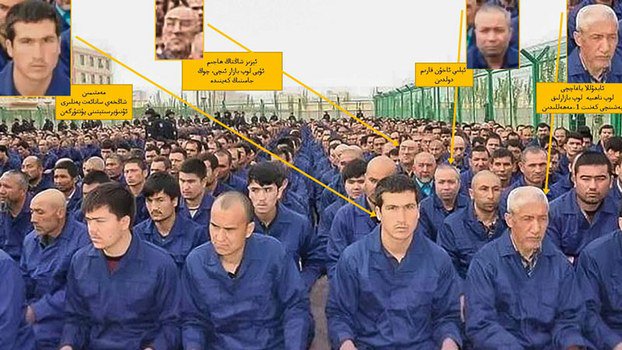
The other form of forced labor is systematic and legal in China’s penal system. Communist China has used forced labor and labor camps, citing “re-education,” since the 1950s. In 2013, the CCP claimed it was abolishing the practice, only to reinstate it a few years later to “re-educate” the Uyghurs. According to the Australian Strategic Policy Institute (ASPI), the Chinese government has built nearly 400 detention camps in Xinjiang. “By most estimates, about 10% of Uyghurs and other Muslim nationalities in Xinjiang have found themselves arbitrarily detained in these camps,” according to Nathan Ruser, a researcher at ASPI.
“Tens of thousands of former detainees have likely been transferred to forced labor programs (…) Xinjiang’s ongoing detention camps (…) underpin a vast network of labor programs where consent is impossible. They taint the supply chains of hundreds of multinational companies with forced labor, and implicate not only the Chinese authorities but much of the rest of the world in a concerted campaign of ethnic replacement that, according to credible reports, may well amount to genocide.”
Although Uyghur forced labor has received much international attention in recent years, a much less well-known fact is that China also subjects Tibetans to forced labor on a large scale and in an organized manner. In the first seven months of 2020, China forced more than half a million Tibetans into forced labor, according to a 2020 report, “Xinjiang’s System of Militarized Vocational Training Comes to Tibet,” by Adrian Zenz for the Jamestown Foundation. According to the report, the CCP has been “re-educating” Tibetans in Tibet in a manner similar to the forced labor it subjects the Uyghurs to in Xinjiang. The report states:
“In 2019 and 2020, the Tibet Autonomous Region (TAR) introduced new policies to promote systematic, centralized, large-scale training and transfer of ‘rural surplus laborers’ to other parts of the TAR, as well as to other provinces of the People’s Republic of China (PRC). In the first 7 months of 2020, the region had trained more than half a million rural surplus laborers through this policy… The labor transfer policy mandates that… farmers undergo centralized, ‘military-style’ vocational training, which aims to reform ‘backward thinking’ and includes training in ‘work discipline,’ law and the Chinese language…”
Judith Bergman, a columnist, lawyer and political analyst, is a Distinguished Senior Fellow at the Gatestone Institute.
This article was originally published by the Gatestone Institute on June 2, 2021.