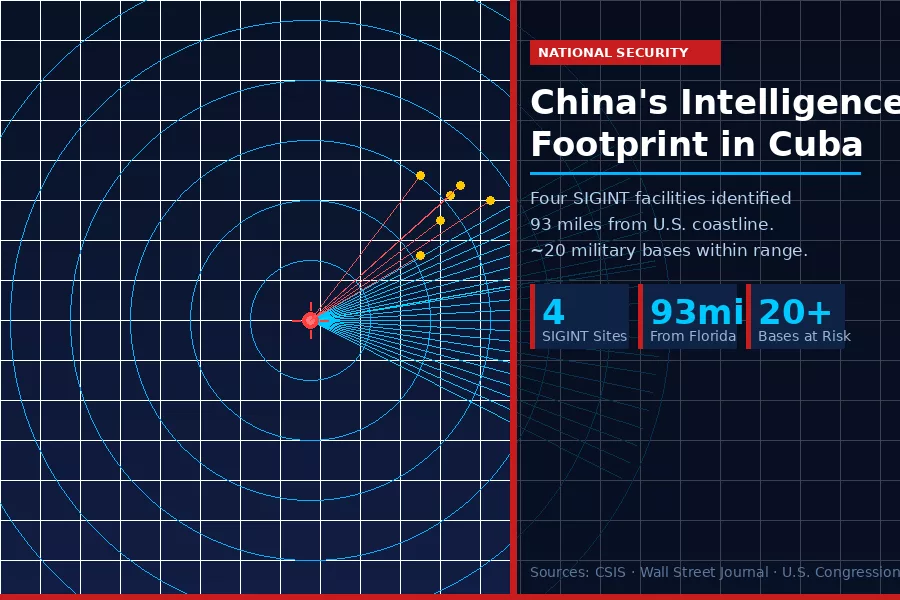





The Chinese Communist Party (CCP) appears to be implementing a multidimensional strategy in the Caribbean, gaining economic, political and potentially military advantages just a few miles off the coast of the United States. The ultimate goal of the CCP’s Caribbean strategy may well be to confront the United States, not only with its presence near the U.S. mainland, but also with a situation analogous to the U.S. military presence in the South China Sea region. There, China created new islands in the sea, pledged not to militarize them, then went ahead and militarized them.
It is important to remember that China also promised Hong Kong’s autonomy until 2047, then, in 2020, moved 27 years earlier. “Hong Kong will be another Communist-run city under China’s strict control,” U.S. Secretary of State Mike Pompeo declared in July. China is clearly not a government that respects its agreements.
CCP leaders also launched a diplomatic effort in the Caribbean aimed at delegitimizing the state of Taiwan, while encouraging countries in the region to open relations with the People’s Republic of China (PRC).
The Chinese dictatorship’s shipments of military and police equipment to several Caribbean states could become a platform for future People’s Liberation Army (PLA) “advisory groups” in the Western Hemisphere. China’s construction projects already include the modernization of airports and seaports, which has increased Chinese geopolitical and military influence in the region. Chinese Defense Minister Wei Fenghe has already officially expressed China’s willingness to deepen military cooperation with Caribbean countries.
In addition, China has been investing considerable revenue in the economies of the anti-American socialist Caribbean states of the hemisphere, Cuba and Venezuela. China’s establishment of a Caribbean sector of the Belt and Road is an opportunity for CCP intelligence agents to undermine the sovereignty of Caribbean countries by drawing these societies into economic dependence on China’s “debt trap.” In Sri Lanka, for example, the country’s inability to pay its Chinese creditors for Beijing’s modernization of the port of Hambantota resulted in the effective loss of the South Asian country’s port.
China’s Caribbean offensive so far has included a “medical diplomacy” initiative that provided Latin America, but especially the region’s island states, with personal protective masks, gowns and gloves, ventilators, ambulances and pharmaceuticals. This May, China convened a vice-ministerial-level video conference on the COVID-19 virus with the nine Caribbean countries that have diplomatic relations with Beijing: Antigua, Barbuda, Barbados, the Bahamas, Dominica, Grenada, Guyana, Suriname, and Trinidad and Tobago.
China’s dominant role as the world leader in the production of pharmaceuticals and medical devices is, presumably as intended, allowing the Chinese regime to gain considerable goodwill in the Caribbean region. China has already delivered 30,000 virus test kits to Jamaica and at least 100,000 protective masks to Cuba, as well as about 100 ventilators to the Dominican Republic. China also built hospitals in Dominica, St. Kitts, Barbados and Trinidad, as well as a children’s hospital in Jamaica. During the COVID-19 epidemic, China also donated medical supplies to about 15 Caribbean states.
Chinese businessmen have invested millions of dollars in tourism-oriented construction projects. China’s state-backed construction companies are building resort complexes in the Bahamas, Guyana and Barbados. Of greatest concern to U.S. security interests is the ongoing port expansion project at the already commercially important port of Kingston, Jamaica, as well as the port of Freeport, Bahamas, a possible new base of operations for China 90 miles off the U.S. coast.
Other China-sponsored port projects are underway at the ports of Santiago and Mariel in Cuba, as well as at the port of Berbice in Guyana. Another Chinese construction project that deserves scrutiny for its implications for U.S. national security is China’s modernization of Guyana’s Cheddi Jagan International Airport. Once the site of U.S. Air Force military operations during World War II, with its runway of more than 3,000 meters, it is capable of hosting Chinese military jet aircraft. However, disagreements over the terms of the original contract signed in 2011 are a source of tension between the Chinese contractor and Guyana’s generally pro-CCP government. China also has an interest in regional access to raw materials such as Jamaican bauxite and offshore oil near Guyana.
The Chinese regime effectively employed “soft power” by spreading anti-American diplomacy through China’s regional ambassadors and Confucius Institutes. Particularly active in this regard is Liu Quan, China’s ambassador to Suriname. China’s propaganda arm established approximately 10 of its 45 pro-Communist Confucius Institutes in the region, in Antigua and Barbuda, Suriname, the Bahamas, Barbados, Cuba, Guyana, Jamaica, Trinidad and Tobago, and Venezuela. These institutes propagate the same pro-Chinese Communist Party, anti-Taiwan ideological line. In addition, the Confucius Institute in Suriname, home to one of the largest overseas Chinese populations in the region, may also be trying to recruit agents.
In 2018, the Dominican Republic revoked its diplomatic ties with Taiwan, presumably to take advantage of the economic opportunities offered by relations with China.
China’s military agenda in the Caribbean region includes the People’s Liberation Army (PLA) Air Force, which donated Chinese Y-12 transport aircraft to Guyana. PLA military aid has reached Jamaica. China-made motorcycles have been exported to West Indian police forces in Trinidad and Tobago, and police cars to Guyana. In addition, selected military officers from virtually every Caribbean country have received training at Chinese military academies.
If China were to establish a beachhead in the Caribbean, the United States could face a dark replay of the 1962 Cuban Missile Crisis. China could insist that the United States reduce, or withdraw entirely, its considerable military force structure in the Western Pacific Ocean in exchange for a reduction of PLA assets in the Caribbean, or some other implausible deal.
U.S. lawmakers must seriously address the aggressive expansionist policies of Communist China in the Caribbean. The United States must not allow the PLA Air Force or PLA Navy to establish bases that could interfere with U.S. freedom of navigation, both for commerce and for military convoys resupplying NATO allies in the event of a military crisis. The United States cannot afford any Chinese push to put any country in the Western Hemisphere under threat, let alone the United States itself.
Author: Lawrence A. Franklin
This article was originally published by Gatestone on December 10, 2020.