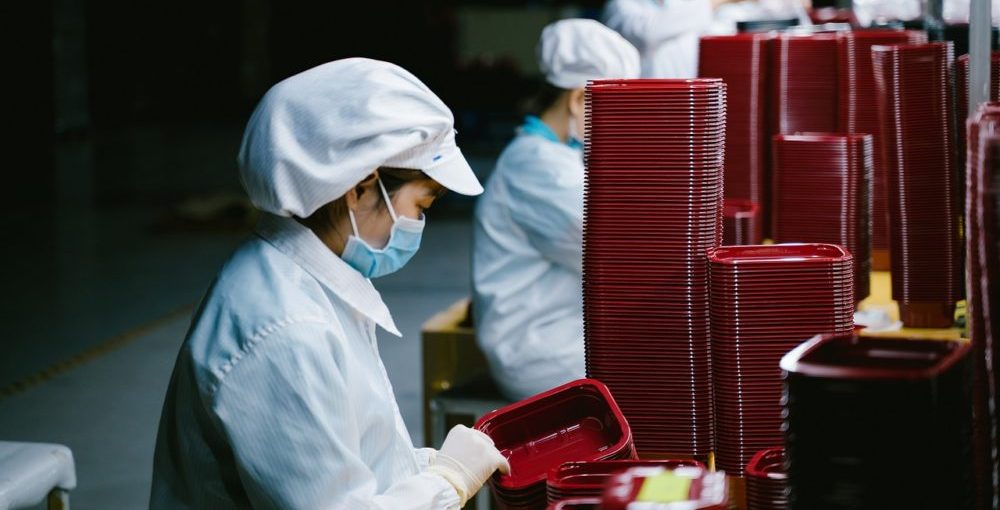



Production costs in China grew in September at the fastest pace in almost 26 years, raising global inflation risks and pressuring local companies to start passing higher costs on to consumers.
The producer price index rose 10.7% from a year earlier, the highest since November 1995, data from the National Bureau of Statistics showed, well above August’s 9.5% increase and the expected 10.5%.
On the other hand, consumer prices rose 0.7% last month from a year earlier, below the previous month’s 0.8% increase, but Bloomberg notes that for now, consumer inflation remains under control thanks to falling pork prices, even though the removal of most virus controls at the end of September may have helped boost household spending.
READ ALSO: China: Systemic Risk Is Greater Than Ever, Expert Warns
“The larger gap between PPI and CPI means greater pressure for upstream sectors to pass on rising costs to downstream ones,” said Bruce Pang, head of macro and strategy research at China Renaissance Securities Hong Kong.
And, as we already warned, the situation is about to get much, much worse. If the historical correlation between coal prices and the Producer Price Index (PPI) holds, we may soon see a tripling of China’s PPI, as the 10.7% year-on-year in September is about to soar to 30% or more.
Needless to say, if China’s PPI reaches 30% or more, even if the Consumer Price Index (CPI) somehow stays in single digits, the results would be catastrophic: profit margins would collapse, the plunge in already scarce cash flows would give rise to even more defaults and bottlenecks in the supply chain, even as the scramble to obtain commodities “at any price” continues to push costs, and the PPI, even higher.
Meanwhile, if producers try to pass on some of the costs and CPI spikes (the gap between CPI and PPI was already at a record level before the recent rise in coal prices) as happened in the early 90s.
Then Beijing will have social unrest on its hands.
There are already signs that producers have begun passing rising production costs on to consumers: China’s largest soy sauce maker said this week it plans to raise retail prices of its products. At least 13 companies listed on China’s A-share market announced price increases this year to cope with rising costs and scarce supply, China Securities Journal reported.
And all this is happening while China’s real estate sector desperately needs a massive liquidity injection which, as you’ve already guessed, is inflationary.
And although China appears to be facing its first “galloping inflation” PPI print since the early 90s, from there it’s all downhill, because as Citigroup recently wrote, power outages (with more than 20 provinces, accounting for more than two-thirds of China’s Gross Domestic Product (GDP), putting electricity rationing measures in place since August) and the PMI contraction “seem to suggest that China may enter at least a brief period of stagflation.”
“We believe the risk of stagflation has risen both in China and in the rest of the world,” said Zhang Zhiwei, chief economist at Pinpoint Asset Management Ltd.
“Persistent inflationary pressure limited the potential scope for monetary policy easing.”
So Beijing is now trapped: if it eases, inflation, which is already at very high levels, will soar even further, crushing margins and causing a deep stagflationary recession; if it doesn’t ease, the real estate market, which is already imploding, will sink.
This article was originally published on ZeroHedge on October 13, 2021.
Author: Tyler Durden