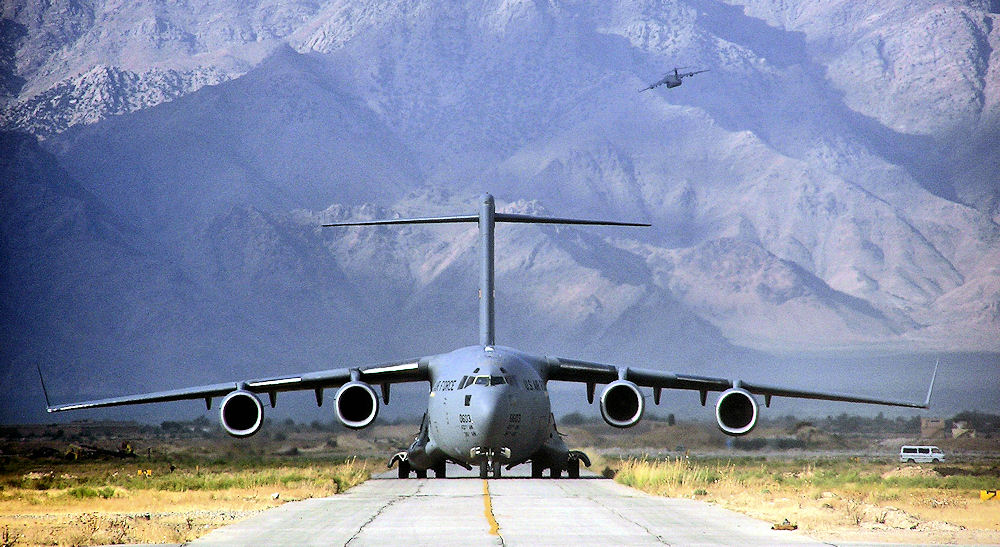



China considered deploying military personnel and economic development officials to Bagram Airfield, perhaps the most prominent symbol of 20 years of US military presence in Afghanistan.
The Chinese military carried out a feasibility study on the effect of sending workers, soldiers and other personnel linked to its overseas economic investment program, known as the Belt and Road Initiative, to Bagram in the coming years, according to a source briefed on the study by Chinese military officials, who spoke to U.S. News on condition of anonymity.
A spokesman for China’s Foreign Ministry denied plans for an imminent takeover of the military airfield, located an hour from Kabul, first established by the Soviets during their own occupation of Afghanistan and which, at the height of the US military presence in the country, was the busiest in the world.
READ ALSO: Communist China’s Growing Aggressiveness in the South China Sea
“What I can say to everyone is that this is purely false information,” Wang Wenbin recently told reporters. China has repeatedly denied many of its other military deployments beyond its borders.
However, the current consideration in Beijing does not concern any pending move, but a possible deployment two years from now, according to the source. And it would not involve seizing the base, but sending personnel and supplies, at the invitation of the Kabul government, after the Taliban secure their hold.
Besides expanding its regional influence, Beijing’s possible plan for Bagram would also be a devastating blow to the image of the United States, which increasingly views China as its most pressing and challenging global threat.
“Given their past experience, the Chinese must be eager to get their hands on what the United States left at the base,” says Yun Sun, director of the China Program at the Stimson Center think tank.
Beijing openly acknowledged Bagram’s geostrategic importance. Its state media covered almost immediately the sudden and surprise departure of the United States from the key logistics hub last July, sending a video crew, which had easy access, to document the aftermath of what it described as a “hasty retreat” and a “humiliating defeat.”
The Chinese regime’s latest consideration matched the usual practices it has perfected in recent years to quietly expand its economic and military influence beyond its borders under the guise of infrastructure investment projects.
For example, the People’s Liberation Army, the official name of the entire Chinese military, has in recent years secured exclusive rights to roughly a third of the naval base it backed at Ream, Cambodia, through an expansion. In Myanmar, it provided radio, radar and other military equipment to the local junta on the Coco Islands, an archipelago about 250 miles south of Yangon, where China has held lease rights for the past three decades. Beijing has said its presence there does not amount to a military base, even though all the equipment, maintenance and training done there come from China.
In fact, it used similar tactics in neighboring Pakistan, with which it strengthened a new security and shared intelligence agreement in recent years, as U.S. News first reported. The Taliban’s revelation that their new government will include as interior minister Sirajuddin Haqqani, the scion of the notorious Pakistani terrorist group, the Haqqani Network, for whom the FBI offers a $10 million reward, further reinforced Islamabad’s position as a conduit between China and its ambitions in Afghanistan.
China can likely achieve its latest ambitions for Bagram with Pakistan’s help, Sun says, adding: “But if it’s feasible, I’m sure they would like to cut out the middleman.”
“If the Taliban request Chinese help, I think China will be inclined to send human support. Most likely they will frame it as technical or logistical support. There is precedent for this in relation to foreign military bases. But a Chinese takeover is unlikely,” she noted.
Apparently anticipating the collapse of the US-backed government, China began in August to make preparations to embrace the Taliban as the legitimate government in Kabul should they take power in Afghanistan, U.S. News first reported, clearing the way for the kind of friendly relations that would allow such deployments to take place. Along with Russia, it notably abstained on a recent UN Security Council resolution that called on the Taliban, among other things, to allow safe passage out of Afghanistan for those wishing to leave.
In fact, the only overseas military facility China has acknowledged is its expeditionary air base in Djibouti, near a similar airfield run by the United States, which both countries use to launch drones and carry out other covert and intelligence operations in the Horn of Africa and around the Gulf states.
The Chinese dictatorship downplayed its presence in Djibouti and flatly rejected the idea that its other overseas outposts are becoming military bases, a likely sign that the current policy of the Chinese Communist Party would not allow an open occupation of Bagram.
This article was originally published in Present Danger China on September 7, 2021
Author: Paul D. Sinkman