




1. Introduction: The Revenge of Geography
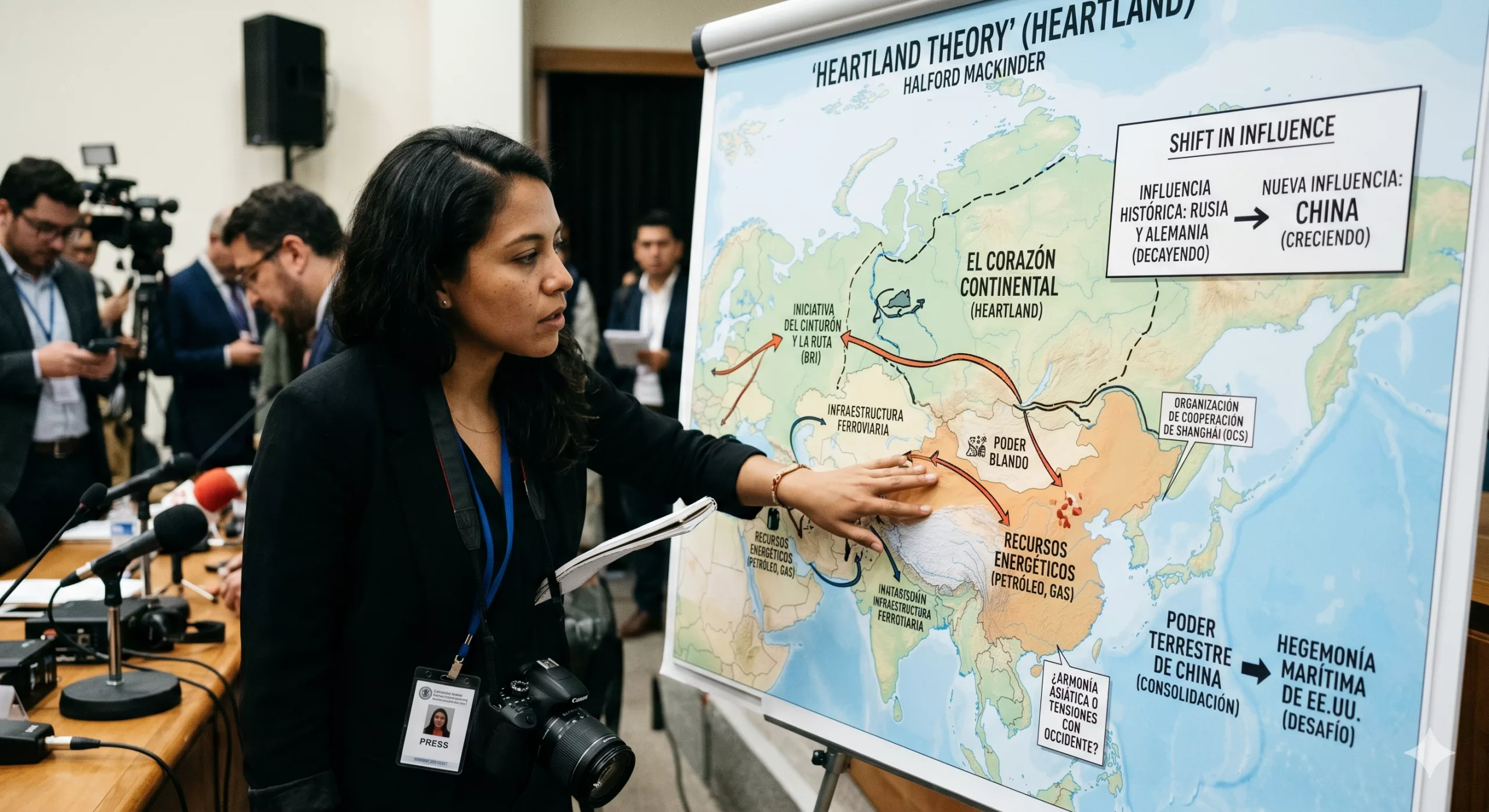
How is it possible that a Victorian-era British geographer drew the master plan of the geopolitical tensions between the United States, Russia and China in the 21st century? The answer lies in what many analysts today call “the revenge of geography.” In 1904, Sir Halford Mackinder presented to the Royal Geographical Society in London a thesis that challenged British hegemony: the end of the “Columbian era,” the era of naval dominance, was near. Mackinder warned that technological development would allow a continental power to consolidate a power so vast that no sea power could counter it. His “Heartland Theory” is not just an academic relic; it is the key to understanding why the final victory, in the great political struggle between land and sea, could belong to the land power of Eurasia.
2. The Prophecy of the Three Lines: The Code of World Domination
In 1919, after the trauma of the Great War, Mackinder refined his thesis in Democratic Ideals and Reality. There he encapsulated his vision in a maxim whose boldness lies in its all-encompassing simplicity. For Mackinder, the destiny of humanity did not depend on scattered colonies, but on control of the “World-Island” (the massive bloc of Eurasia and Africa). Access to this continental heart required a master key: Eastern Europe.
“Who rules East Europe commands the Heartland; who rules the Heartland commands the World-Island; who rules the World-Island commands the world.”
This vision was not a simple cartographic exercise. Mackinder understood that a nation’s “Essential Security” depends on insurmountable physical barriers. Control of Eastern Europe made it possible to close the door to maritime powers and secure the resources of an unreachable interior.
3. The “Heart of the Earth”: An Unreachable Geographic Fortress
For the modern strategist, it is vital to distinguish between the “Pivot Area” of 1904 and the “Heartland” of 1919. Originally, Mackinder defined the Pivot as an area of inland drainage (toward the Arctic or inland lakes) that extended from the Volga to Siberia, protected by ice and the Himalayas. In 1919, however, he expanded these limits westward, including the Baltic Sea and the Danube, making Eastern Europe the hinge of global power.
What made this territory special was its naval invulnerability. While the United States plays its naval “ace of spades” in the so-called Inner Crescent or Rimland, that coastal arc running from Scandinavia to Manchuria, the Heartland remains out of reach of oceanic fleets. There is a deep irony in the fact that regions the West usually perceives as desolate or frozen are in reality the defensive epicenter of the world, protected by the very structure of the planet against the incursions of any maritime empire.
4. The Relay of Giants: From Tsarist Russia to the China of the Silk Road
During the 20th century, the Soviet Union was the Pivot State par excellence. However, its collapse, marked by fragmentation into sovereign republics, ideological change and economic stagnation, left a vacancy on the throne of Eurasia. Today, China has claimed that place, replacing Germany and the USSR as the land giant that challenges American hegemony.
The meteoric rise of China’s GDP is not just an economic metric, but the basis of a strategic expansion into Central Asia. This ambition is not subtle. General Liu Yazhou of the People’s Liberation Army (PLA) has defined the importance of this region with absolute military frankness:
“[Central Asia is] the thickest piece of cake that heaven has given to modern Chinese.”
5. The End of the Naval “Ace of Spades”: Railways and Pipelines
Mackinder’s prophecy that the railway would surpass maritime transport is being validated by 21st-century technology. The “One Belt, One Road” project (the New Silk Road) is the hammer breaking the Western maritime encirclement. A critical example is the Yuxinou railway, which connects Chongqing directly with Europe via Xinjiang and Kazakhstan.
This 10,000-kilometer infrastructure is not just a trade route; it is a geopolitical bypass maneuver that allows China to ignore the bottlenecks controlled by the U.S., such as the Strait of Malacca or the Suez Canal. With trade between China and Central Asia having multiplied a hundredfold since relations were normalized, physical connectivity in Eurasia has become the modern tool of conquest. China is neutralizing the American “naval trump card” by turning dry land into the highway of global power.
6. The “Charm Offensive” and the Harmonization of the Heartland
Beijing has understood that controlling Eurasia requires more than asphalt and rails; it requires stability. Its strategy is based on neutralizing the “Three Evils” (terrorism, separatism and extremism) emanating from its western borders, especially in Xinjiang. To achieve this, it has deployed a “Charm Offensive” that combines the hard power of the Shanghai Cooperation Organization (SCO), an institutional counterweight to NATO, with the soft power of culture.
With seven Confucius Institutes strategically located in Central Asia (two in Kazakhstan, two in Kyrgyzstan and one each in Tajikistan, Turkmenistan and Uzbekistan), China seeks to “pacify and enrich” its neighbors. This “harmonious world vision” is a direct response to the “China Threat Theory,” designed to secure access to the region’s oil and gas resources under a cloak of multilateral cooperation that anchors the Central Asian nations to Beijing’s orbit.
7. Conclusion: The Return of the Continental Giant
Halford Mackinder was criticized in his time for failing to foresee the impact of air power on geography. Yet China is correcting that historical error by integrating air power, high-speed railways and a massive pipeline network into a single matrix of land power. The immensity of Eurasia, its central location and its wealth of resources remain the gravitational factors of the world order.
We are witnessing the return of the continental giant. China is not only occupying the Heartland; it is “harmonizing” it under a new logistical and political design. If Mackinder was right and control of the World-Island is the final step toward global hegemony, we must seriously ask ourselves: are we witnessing the last days of Western primacy as we know it, in the face of the resurgence of an order centered on the heart of the land?