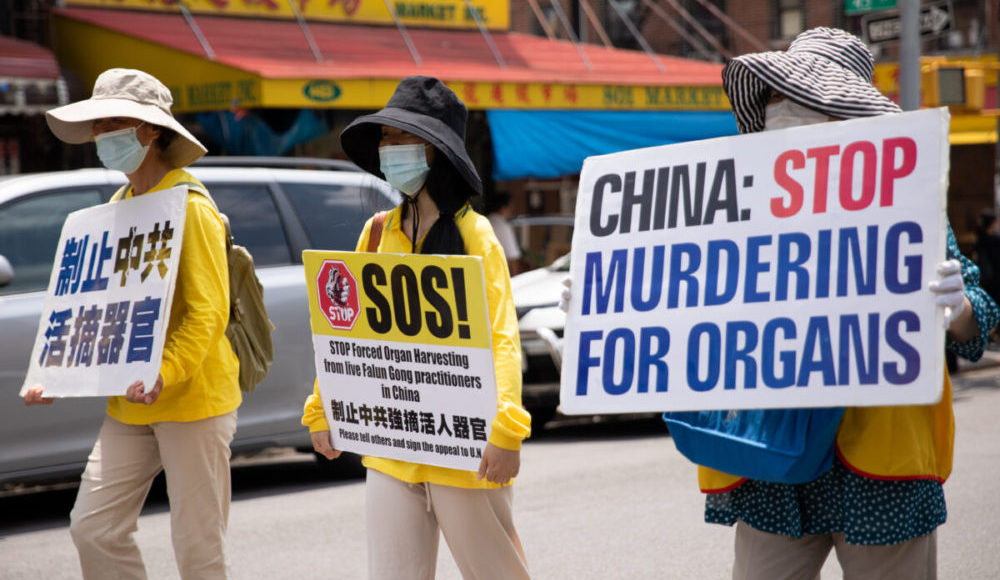





Numerous press articles continue to appear describing the ongoing problem of human organ harvesting in China, including forced organ harvesting in Chinese military concentration camps, where human rights abuses are part of a for-profit industry.
One of the centers accused of organ harvesting is the First Hospital of Jilin University, which until 2000 was known as the Affiliated Hospital of the First Military Medical University of the Chinese People’s Liberation Army (PLA) in Changchun, China.
It is important to note that the pathobiology and zoonosis research laboratories of Jilin University are associated with the PLA Military Veterinary Institute, which represents an element of the military-civil fusion mandated by the Chinese Communist Party’s (CCP) 2016 13th Five-Year Plan.
READ ALSO: Report: Inside China’s Secret RSDL Jails
On October 11, 2021, Megan Sykes of Columbia University in New York and Yong-Guang Yang published a scientific paper that listed their affiliations as Columbia University and the Organ Regeneration and Transplantation Laboratory of the First Hospital of Jilin University.
That scientific study was funded by grant AI045897 from Anthony Fauci’s National Institute of Allergy and Infectious Diseases (NIAID) and National Institutes of Health (NIH) grant 1S10RR027050 for the CCTI Flow Cytometry Core (CCTI).
It represents the culmination of what could be considered just one example of the thousands that describe how Chinese scientists come to the United States, access American knowledge, skills, technology and funding, but maintain their loyalty and support for the goals of the Chinese Communist Party.
Between 2006 and 2018, Yong-Guang Yang received $6.6 million in NIH funding, most of it from Anthony Fauci’s National Institute of Allergy and Infectious Diseases (NIAID).
According to his publication record, Yong-Guang Yang began officially working with the First Hospital of Jilin University in 2010, research supported by NIAID grants from Anthony Fauci to Yong-Guang Yang (AI064569) and Megan Sykes (AI045897).
In a 2011 study, also funded by Anthony Fauci’s NIAID, Yong-Guang Yang worked with Chunfeng Wang of Jilin University, a collaborator (2014) and (2020) of the PLA Military Veterinary Institute, a center allegedly linked to China’s biological warfare program.
Around 2012, Yong-Guang Yang began training Chinese scientists from the First Hospital of Jilin University in his laboratory at Columbia University, using NIH funds to do so.
Yong-Guang Yang also conducted a scientific study with the PLA in 2018, funded by NIH grants AI079087 and HL130724.
By 2019, Yong-Guang Yang became an official member of the Organ Regeneration and Transplantation Laboratory of the First Hospital of Jilin University; of the International Center for Future Science; and of the National Joint Engineering Laboratory of Animal Models for Human Diseases of China, all while maintaining his affiliation with Columbia University.
The research that led to a 2020 scientific publication by Yong-Guang Yang and his Chinese colleagues at Jilin University was supported by Anthony Fauci’s NIAID grant AI 064569 and the CCTI flow cytometry core, funded through an NIH shared instrumentation grant (1S10RR027050).
At a time yet to be determined, Yong-Guang Yang became a scientific advisor to Jilin Zhongke Bio-Engineering Co., Ltd in Changchun, Jilin, China, a biotechnology company focused on organ transplantation and regeneration.
According to a Chinese-language article dated November 23, 2020, Jilin Zhongke Bio-Engineering:
“Established an Academic Workstation in cooperation with Academician Jin Ningyi, and hired a tenured professor of Columbia University and national professor Yang Yongguang, an expert of the Thousand Talents Program, who acts as the chief expert in the research and application of immune cells.”
Ningyi Jin is a major general of the PLA and director of the PLA Military Veterinary Institute, whose activities are linked to China’s biological warfare program.
Further information on Jilin Zhongke’s bioengineering is revealing.
Another of its scientific advisors is Major General Wei-min Wang, of the Standing Committee of the Medical Science and Technology Committee of the PLA Guangzhou Military Region.
One of the key technologies acquired by Jilin Zhongke Bio-Engineering is the flow cytometer, the same technology defined in NIH Shared Instrumentation Grant 1S10RR027050 for the CCTI Flow Cytometry Core, cited by Yong-Guang Yang and Megan Sykes in their collaborations with the First Hospital of Jilin University.
According to a profile provided by Jilin Zhongke Bio-Engineering, Yong-Guang Yang, while working at Columbia University and being funded by the NIH, has been leading a secret life, apparently as an operative of the Chinese Communist Party, where he is listed as:
- Chief scientist of the National 973 Program, also known as the National Basic Research Program, a basic research program launched by the People’s Republic of China to gain technology and strategic advantage in various scientific fields.
- Distinguished expert of the national “Thousand Talents Plan”, to recognize and recruit leading international experts in scientific research, innovation and entrepreneurship. Both the United States and Canada have warned that China intends to use scientists participating in this plan to access new technologies in order to obtain economic and military advantages.
- Winner of China’s National Science Fund for Distinguished Young Scholars.
- Chief scientist of the “Twelfth Five-Year Plan” Special Program (2011-2015) for major infectious diseases in science and technology.
Vice dean of the Institute of Translational Medicine at the First Bethune Hospital of Jilin University. - Director of the Institute of Immunology at Jilin University.
- Director of the International Joint Research Center for Genetic Medicine and Animal Models of Human Diseases.
- Director of the National and Local Joint Engineering Laboratory of Animal Models of Human Diseases.
- Director of the Key Laboratory of Tissue Engineering and Animal Models of Human Diseases of Jilin Province.
US-based scientists, both Chinese and American, are directly or indirectly subsidizing China’s economy and military and possibly contributing to human rights violations such as forced organ harvesting.
Unfortunately, there is absolutely no national security accountability for US research funding involving China.
This article was originally published on Gateway Pundit on November 26, 2021.
Author: Joe Hoft