

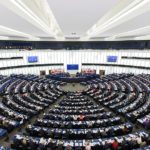
A European Parliament (EP) committee on Wednesday adopted a resolution calling for closer ties between the European Union (EU) and Taiwan, while warning for the first time of China’s “military belligerence” against the democratic island and its 23.5 million citizens.
The European Parliament’s Foreign Affairs Committee voted 60 to four in favor of the report “EU-Taiwan Political Relations and Cooperation,” which calls on the European Commission (EC) to assess the possibility of an EU-Taiwan Bilateral Investment Agreement (BIA).
Six lawmakers abstained in the September 1 vote, which also approved an amendment to change the name of the “European Economic and Trade Office” in Taipei to the more formal “European Union Office in Taiwan.”
READ ALSO: China Uses the Situation in Afghanistan to Threaten Taiwan and Steal Minerals
Taiwan’s Ministry of Foreign Affairs on Thursday expressed its “sincere gratitude” to the committee, saying it welcomes the new milestone in its relationship with the European bloc, which encouraged member states to deepen ties with Taipei within the EU’s own “one China” policy.
That same day, China’s mission in Brussels voiced its opposition to the resolution.
In a statement on its website, a spokesperson described the report as going beyond “the scope of unofficial economic and trade cooperation and cultural exchanges” between the EU and Taiwan, which China claims is part of its territory.
The foreign affairs committee approved the resolution “despite China’s repeated objections,” the statement said, urging committee members to “appreciate the sensitivity of the Taiwan question.”
German Green MEP Reinhard Bütikofer said recently in a tweet that Beijing tried to stop the Taiwan report, the first of its kind adopted by the committee, by appealing to EP President David Sassoli.
“China’s ambassador to the EU took this up earlier with EP President David Sassoli, trying in vain to stop the adoption,” Bütikofer wrote. The EP will vote on the resolution in a plenary session in October, he added.
In a recent press release, the committee described Taiwan as “a key EU partner and democratic ally in the Indo-Pacific that contributes to maintaining a rules-based order amid increasingly intense great-power rivalry in the region.”
It said the EU-Taiwan report “expressed serious concern over the continuing military belligerence, pressure, assault exercises, airspace violations and disinformation campaigns against Taiwan” and urged the EU to do more to address these tensions and protect Taiwan’s democracy and the island’s status as an important EU partner.
The statement continues: “MEPs insist that any change in cross-strait relations must be neither unilateral nor contrary to the will of Taiwanese citizens. In addition, they starkly recall the direct connection between European prosperity and Asian security and the consequences for Europe if a conflict were to extend beyond the economic sphere.”
Swedish Democrat MEP Charlie Weimers, the report’s rapporteur, said the EC must work on “an impact assessment, a public consultation and a scoping exercise” for the EU-Taiwan BIA before the end of the year.
“The Commission must now step up EU-Taiwan relations and pursue an enhanced comprehensive partnership with Taiwan,” he said in the committee’s statement to the press.
None of the EU member states have formal diplomatic relations with Taiwan, which has several missions in Europe that serve as de facto embassies.
The EU recently backed Lithuania’s decision to establish a Taiwanese Representative Office in the country, the first to bear the word “Taiwan” instead of the deliberately ambiguous “Taipei.”
China recalled its ambassador to Vilnius and expelled Lithuania’s top envoy from Beijing last month. Lithuania’s business sectors are reportedly preparing for indirect economic sanctions from China.
China’s relations with the EU took a significant hit when the EP voted to suspend ratification of a trade deal agreed in December. That came after the EU sanctioned Chinese officials it said were responsible for human rights violations in Xinjiang, before Beijing announced its own punitive measures in return.
The retaliatory sanctions targeted, among others, German MEP Bütikofer and Xinjiang researcher Adrian Zenz.
The Chinese regime considers Xinjiang and Taiwan among its “core interests.” It protested a statement by the United States and the EU that mentioned Taiwan in June, when President Joe Biden met with European allies.
This article was originally published in Newsweek on September 2, 2021
Author: John Feng