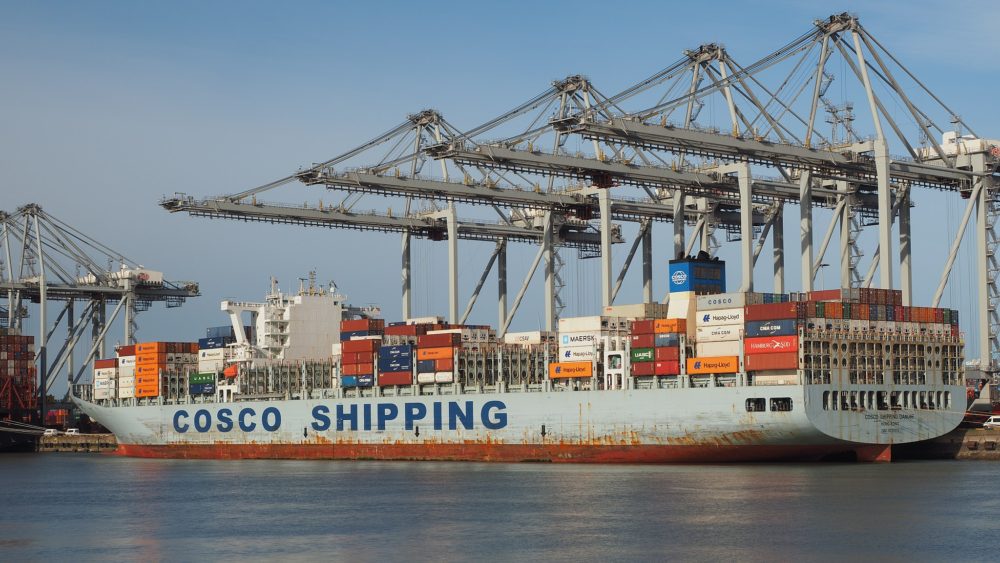




Through investment in and ownership of ports, China has expanded its global maritime reach, and its appetite for ports shows no sign of waning. In July 2020, Chinese companies reportedly “owned or partially operated some ninety-five ports around the world.”
Of the 95 ports, 22 are in Europe, 20 in the Middle East and North Africa, 18 in the Americas, 18 in South and Southeast Asia and nine in sub-Saharan Africa. Just three Chinese companies, including COSCO Shipping Ports and China Merchants Port, two central state-owned enterprises, handle the operation of 81% of those ports.
In China, COSCO has been designated as one of the 53 most “important state-owned enterprises,” according to a February 2021 report by the Australian Strategic Policy Institute (ASPI). The report noted:
“COSCO’s status as an important state-owned enterprise means it is beholden to the Chinese Communist Party (CCP) in a way that other state-owned enterprises are not. COSCO’s organizational structure includes paramilitary capabilities that can be mobilized by the Chinese regime to defeat threats to CCP interests. One of these capabilities is the company’s internal militia.”
READ ALSO: Communist China’s Growing Aggressiveness in the South China Sea
Most of China’s overseas port investments and operations are concentrated in a small handful of Chinese state-owned companies, especially COSCO, the world’s third-largest container carrier and fifth-largest port terminal operator.
In May, COSCO signed an agreement to build a new port in Peru, near its capital, Lima.
In June, COSCO increased its stake in the Piraeus Port Authority in Greece to 67%. COSCO had already acquired Piraeus’s two main container terminals on a 35-year lease in 2008, and the third in 2016. Also in June, COSCO, which already owns terminals in Spain, in Valencia and Bilbao, announced that, through its Spanish subsidiary, it would launch a new rail freight service between Valencia and Zaragoza.
In September, COSCO acquired a 35% stake in the Hamburg container terminal. Hamburg is Germany’s largest seaport and Europe’s second-largest container port.
COSCO has been described as the “main supplier of the People’s Liberation Army Navy (PLAN), providing Beijing with onshore support for the PLAN through a commercial enterprise structured to align with Chinese naval strategy, to the point that some naval analysts refer to COSCO as the fifth arm of the PLAN.”
Also in September, Shanghai International Port Group (SIPG), another Chinese state-owned company, began operating the new Haifa port terminal, Israel’s largest container terminal. As part of the agreement, SIPG will do so for the next 25 years.
Although, at first glance, China’s port acquisitions appear to be mere commercial transactions based on an economic agenda, the rhetoric China uses notwithstanding, several analysts have pointed out that geopolitical concerns appear to be what really drives China’s port investments. While China’s port acquisitions secure its strategic supply lines, for example of oil and gas from the Middle East, analysts suggested that the strategy also includes a military functionality. According to a 2020 report by the Asia Society Policy Institute:
“A deliberate military and strategic functionality appears clearly embedded in the initiative. But the security challenge for US or regional interests does not lie in the risk of a “string of pearls” chain of overseas coastal fortifications from which the PLA can wage war and which it will defend. So far there is little evidence that Beijing is building full-fledged overseas military bases on the US model, but there is abundant evidence that it is developing a network of strategic strongpoints that can significantly raise the costs of any US military intervention and reduce the willingness of BRI [Belt and Road Initiative] affiliated governments to offer access or assistance to the United States.”
“The PLAN [People’s Liberation Army Navy] relies on commercial ports to support its growing overseas operations,” Isaac Kardon, an assistant professor at the US Naval War College, stated at the US-China Economic and Security Review Commission hearing on the PLA’s global power projection capabilities on February 20, 2020.
“However, the distinctive aspect of the PLAN’s efforts to support a growing overseas presence is its access to a large and growing number of ports (partly) owned and operated by companies of the People’s Republic of China (PRC). PLA officers and Chinese analysts tout a variety of possible dual-use functions at these ports, which in some cases have been called China’s overseas “strategic strongpoints.””
Concern that China’s acquisition of commercial ports around the world could be used for strategic purposes was reinforced by indications that some COSCO acquisitions were made at prices so high that “obtaining those assets is a matter of achieving strategic national security objectives, rather than a financial investment that must provide market-based returns.”
China’s port acquisitions and operations pose certain risks for US Navy ships that call at ports under Chinese management. Admiral Gary Roughead, a former US Chief of Naval Operations, said in 2019:
“US Navy ships might not regularly call at Chinese-managed ports because of the risk that commercial ports’ information technology (IT) systems could be used to monitor or interfere with military systems and endanger US information and cybersecurity.”
For this reason, the US warned Israel that China’s management of the new Haifa port terminal could harm US-Israeli security cooperation, as it could lead US Navy ships to refrain from docking there.
In a 2019 article in the Naval War College Review, Christopher R. O’Dea wrote:
“By creating a global port network for ostensibly commercial purposes, China gained the ability to project power through the increased physical presence of its naval vessels, turning the oceans that have historically protected the United States from foreign threats into a place where China can challenge American interests.”
Another serious concern is that Chinese port investments create economic and political leverage for the Chinese Communist Party (CCP) that can affect local politics and decision-making. Greece is an example: after China invested in and acquired much of the port of Piraeus, Greece blocked an EU statement criticizing China’s human rights record at the UN. A Greek Foreign Ministry spokesman said at the time:
“Greece’s position is that unproductive and in many cases selective criticism against specific countries does not facilitate the promotion of human rights in these states, nor the development of their relationship with the EU.”
Greece also prevented a unified EU statement against China’s behavior in the South China Sea when the Permanent Court of Arbitration ruled against Beijing’s sovereignty claims over most of the South China Sea in 2016, and Greece opposed tightening scrutiny of Chinese investments in Europe, a foreseeable move for all nations that become indebted to Chinese investment.
This article was originally published by Gatestone on October 5, 2021
Author: Judith Bergman