
At the heart of contemporary Chinese politics exists a concept that, at first glance, seems taken from a biology manual, but is actually the cornerstone of state indoctrination: “red genes” (or hongse jiyin). This term refers to the inheritance of the revolutionary spirit and history of the Chinese Communist Party (CCP), used as a tool to consolidate national identity and legitimize the regime. Although the concept began to take shape in military circles around 2008, it has been under Xi Jinping’s mandate that it has become the hallmark of a massive campaign of social and cultural engineering.
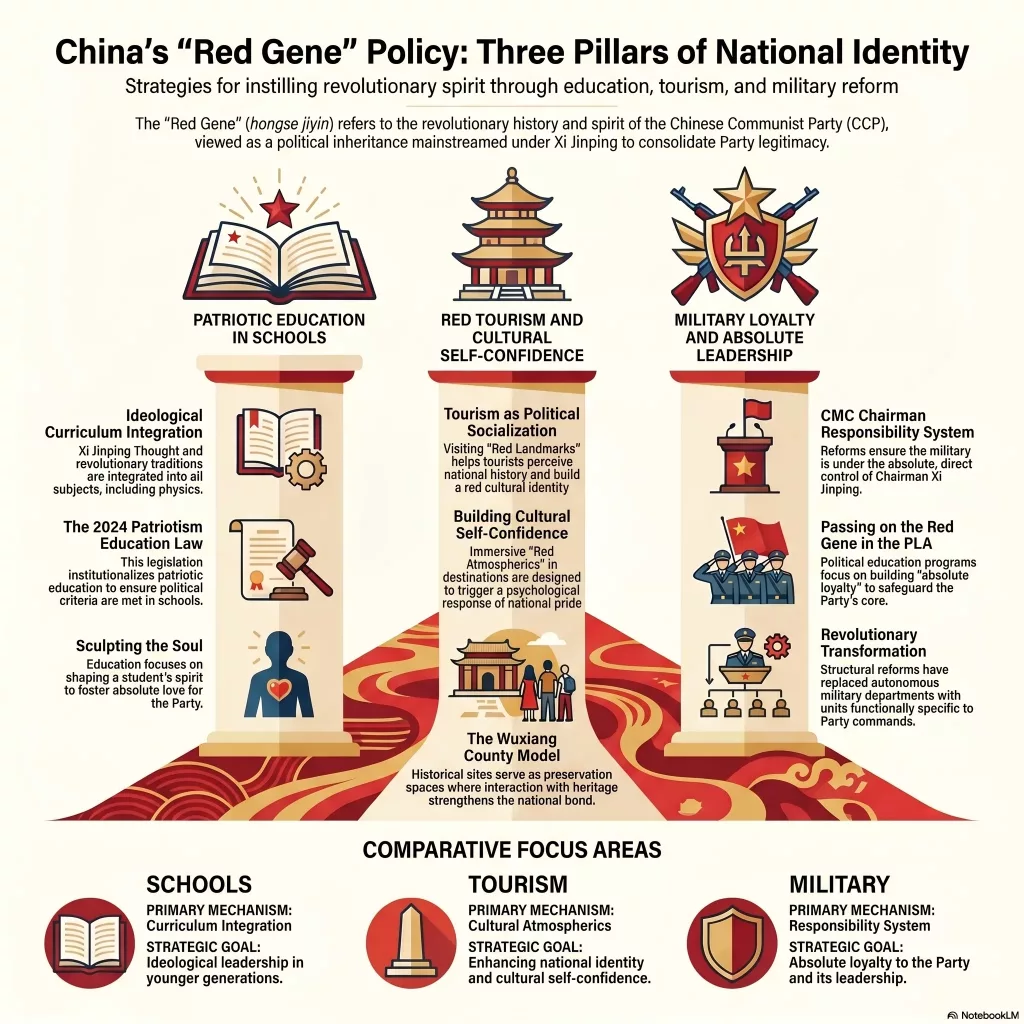
To understand the depth of this policy, we must observe where it begins: in basic education. The government has set its sights on primary and middle school students in an effort to instill a love for the Party and promote “socialist core values” from childhood. Chinese lawmakers have officially proposed initiatives such as the “red gene transmission project” in classrooms, whose purpose is twofold: to foster patriotism and combat “historical nihilism,” a label used to discredit any view of history that questions revolutionary heroes or State dogmas.
However, this ideological insertion has reached levels that many consider disproportionate. Critics on international platforms have pointed out with concern how political indoctrination and Xi Jinping Thought have begun to permeate not only humanities subjects, but even the forewords of physics textbooks, subordinating scientific objectivity to State ideology.
As we delve deeper, we note that the State’s pedagogical strategy has evolved and become much more sophisticated. The government knows that traditional forced memorization generates rejection. Therefore, historical education is transitioning towards what Chinese theorists call “endogenous education”. The goal is no longer the simple “injection” of knowledge, but the construction of immersive scenarios and “question-based teaching” that manages to stimulate an internal drive and real emotional resonance. The aim is for young people to internalize the national narrative not as a civic obligation, but as their own conviction and a development of historical empathy, transforming interest into true national identity.
This ideological immersion does not end when the school bell rings; it extends to society’s leisure through “red tourism”. This form of tourism is strongly promoted by the government as an experiential vehicle to impart patriotic education and strengthen the Party’s identity. To achieve this, revolutionary tourist destinations design a meticulously calculated “red cultural atmosphere,” which consists of three dimensions: the physical (landscapes, architecture, souvenirs), the spiritual (the pride and attitude transmitted by local residents), and the institutional (order and behavioral norms). Scholars from the China Media Project describe this monumental effort not as a traditional mass campaign, but as a State-driven “mass simulation”, where the population is urged to adopt the history of the CCP as a central and inseparable component of the ancient Chinese culture itself.
At the macro level, this ideological machinery is solidly cemented in the country’s strategic planning. The Five-Year Plan (2026-2030) explicitly underscores the use of Xi Jinping Thought to “mold the minds and cultivate the character” of students, as well as the revitalization of old revolutionary bases to perpetuate the “red genes” and strengthen local industries.
Finally, at the pinnacle of power and armed force, this ideological genetics is treated as a matter of survival and national security. The sweeping reforms driven by Xi Jinping in the People’s Liberation Army (PLA) demand the unswerving implementation of the responsibility system of the Chairman of the Central Military Commission. For the Chinese armed forces of the new era, carrying the “red gene” is no longer just a cultural metaphor, but a requirement of absolute political loyalty, unswerving obedience, and iron discipline toward the Party and its supreme leader.
In short, the narrative of the “red genes” reveals an unprecedented all-encompassing project. What begins in childhood as the teaching of basic concepts of national pride is systematically deepened through emotional pedagogy, immersive tourism, cultural control, and military reform, aspiring to become the DNA of an entire nation. The great underlying question is whether this rewriting of the cultural genetic code will succeed in consolidating the unshakeable unity the regime pursues, or if the weight of subordinating science, logic, and critical thinking to ideological loyalty will end up hindering the true potential of Chinese society.
| Term or Concept | Definition and Scope | Origins and Key Proponents | Implementation Method | Institutional Application |
| Red Genes (hongse jiyin) | Refers to the revolutionary spirit, history, and ethos of the Chinese Communist Party (CPC) as a political, cultural, and hereditary inheritance. It serves as a foundational element of national identity, cultural confidence, and regime legitimacy. | Emerged in 2008 (Hu Jintao era) via the PLA Daily; significantly elevated by Xi Jinping as a signature governance component. Key proponents include Bo Xilai (red culture), Liu Xianglian (NPC deputy), and Su Wei (Party School). | Integrated into school curricula and textbooks, military political education, red tourism, and “red” digital forums. Focused on preserving revolutionary history and protecting the reputation of heroes through national planning. | The People’s Liberation Army (PLA), Ministry of Veterans Affairs, Ministry of Education, Central Military Commission, and the Party School system. |
| Red Gene Transmission Project | An educational and legislative initiative designed to foster loyalty to the CPC and the state by institutionalizing the study of revolutionary history. | Proposed by Liu Xianglian, a deputy to the 13th National People’s Congress (Henan Province). | Strengthening revolutionary education in schools and formal academic sessions; utilizing “red assets” (revolutionary sites) for local education to prevent the “smearing” of historical figures. | Elementary and high schools; local municipal and county governments managing revolutionary base areas. |
| Countering Historical Nihilism | A strategic policy aimed at suppressing interpretations of history that “smear” revolutionary heroes or challenge the Party’s official historical narrative. | Central leadership and legislative deputies such as Liu Xianglian. | Drafting and enforcing laws for the protection of the honor of heroes and martyrs; applying administrative and criminal sanctions against “incorrect values.” | National People’s Congress (legislation) and Public Security Bureaus (enforcement). |